Updated 25 November 2025.
Selecting the right propulsion system is one of the most important design decisions for any vessel, and for offshore wind farm vessels, it is mission-critical. Crew Transfer Vessels (CTVs) operate in challenging conditions, require precise manoeuvrability, and must consistently deliver technicians safely to turbines. Choosing an unsuitable propulsion system can lead to increased fuel consumption, reduced uptime, safety limitations and weaker competitiveness.
This article explains the operational profile of wind farm vessels, how CPP technology works, and why a controllable pitch propeller remains the most versatile and future-proof propulsion solution in the offshore wind sector.

Optional Profile of Offshore Wind Farm Vessels
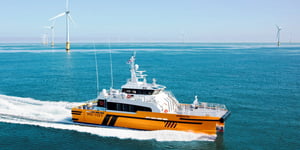
Wind farm vessels, especially CTVs, operate in dynamic environments with a combination of high-speed transit, low-speed manoeuvring, and high bollard-push operations. A propulsion system must perform reliably across all three.
Typical Characteristics of a Modern CTV
- Length: 20–30 metres
- Capacity: 12–24 technicians
- Payload: commonly 8–10 tonnes (tools, spare parts, fuel)
- Operating hours: often 3,000–4,000 hours per year
- Weather window dependency: uptime is strongly influenced by vessel handling in challenging sea states
Key Operational Modes
1. High-Speed Transit to the Wind Farm
CTVs frequently travel long distances at 20–30 knots. They must:
- handle high waves and strong winds
- maintain stability under varying deck loads
- ensure fuel-efficient long-distance operations
This is the most energy-demanding mode.
2. Medium/Low-Speed Manoeuvring Inside the Wind Farm
Once at the site, vessels operate at 10–20 knots while navigating between turbines and preparing for transfer operations.
3. Bollard Push and Turbine Push-On Operations
Safely transferring personnel requires:
- high bollard push
- excellent low-speed control
- strong station-keeping capability even in harsh conditions
These diverse operating modes place unique demands on the propulsion system — demands a CPP is particularly suited to handle.
Read more: The Most Valuable Energy is the One You Do Not Use
Understanding Controllable Pitch Propellers (CPPs)
The CPP is a propeller with changeable pitch. Meaning that the propeller pitch can be adjusted for optimum load on the engines and adjusted to different conditions such as varying vessel load, weather conditions and operation modes.
Consequently, this propulsion system can be used to run the vessel in forward and astern direction both, by turning the propeller blades in aft pitch setting without having to change the direction of rotation of the shaft. Smooth manoeuvring reducing wear and tear on the engines will also reduce engine maintenance cost.
Also, with a hybrid solution you’ll have optimal propeller pitch when in EL-mode.
Why CPPs Are the Preferred Choice for Wind Farm Vessels
1. Superior Bollard Push and Personnel Transfer Control
Transfer operations demand precise bow control against the turbine transition piece. CPPs offer:
- high bollard push through optimised low-pitch settings
- reliable push-on in varying sea states
- improved safety and uptime in critical operations
2. Fuel-Efficient Transit Operations
By adjusting pitch, CPPs allow the engine to operate close to its optimal efficiency point. This typically results in:
- reduced fuel burn during high-speed transit
- smoother operation in varying vessel load conditions
- lower total operational cost (OPEX)
3. Higher Uptime Through an Expanded Weather Window
Better thrust control and improved low-speed manoeuvrability mean CPP-equipped vessels can operate safely in larger weather windows. This increases:
- operational availability
- revenue per vessel
- reliability of daily transfers
4. Ideal for Hybrid and Electric Solutions
Hybrid-electric propulsion is rapidly growing in offshore wind. A CPP provides:
- optimal pitch for low-power electric transit
- near-silent operation in harbours
- flexible integration with battery-based energy systems
The global market for marine hybrid propulsion is projected to more than double approaching 2030, making future-ready propulsion systems increasingly important.
5. More Efficient Across All Operational Modes
Whether the vessel is:
- transiting
- holding position
- manoeuvring between turbines
- conducting push-on transfer
…a CPP adapts instantly. Fixed-pitch propellers (FPPs) simply cannot match this operational flexibility.
Read more: What is Important When Selecting Propulsion Technology
Conclusion
Choosing the wrong propulsion system for a wind farm vessel can limit safety, fuel efficiency, uptime and competitiveness. A controllable pitch propeller provides the flexibility, thrust, control and hybrid compatibility required for modern offshore wind operations.
From high-speed transit to precision push-on manoeuvres, CPPs deliver reliable performance across all operational modes, making them the preferred choice for current and next-generation offshore wind farm vessels.
![[Cover]-EN-Servogear-Concept-Brochure-Propulsion-Efficiency-Beyond-Belief](https://hubspot-no-cache-eu1-prod.s3.amazonaws.com/cta/default/26627183/interactive-96011088080.png)