Updated 24 November 2025.
Selecting the right propulsion system is a defining factor for the performance, efficiency and cost of any vessel. Among the propulsion solutions commonly used in high-speed and workboat applications are the Water Jet (WJ), the Fixed Pitch Propeller (FPP) and the Controllable Pitch Propeller (CPP). Each technology has strengths and limitations — but when fuel efficiency, thrust performance and operational flexibility matter, the differences become significant.
In this article, we will discuss the differences between the WJ and the CPP, highlight their operational characteristics, and explain how converting from Water Jet to CPP can yield substantial fuel savings, lower emissions and reduce total cost of ownership.

Understanding the Two Propulsion Systems
How a Water Jet Works
A Water Jet generates thrust by accelerating a high-speed stream of water through a pump and nozzle. Thrust is created by reaction force, pushing water aft to drive the vessel forward.
Key characteristics:
- No external rotating propeller
- Very high manoeuvrability
- Well-suited for shallow waters
- High speed potential
How a CPP Works
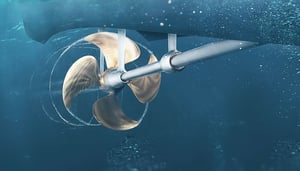
A Controllable Pitch Propeller uses blades with a fixed diameter but adjustable pitch, meaning the blade angle can be continuously optimized during operation.
Key characteristics:
- High efficiency across multiple speeds
- Strong thrust at low speeds
- No need to reverse shaft rotation for astern movement
- Excellent load-handling capability
Cost, Efficiency and Environmental Impact
When selecting a propulsion system for your vessel, it is important to consider the different variables or characteristics that are important to your means of operation. Both the Water Jet and the CPP has great features and advantages, it really just depends on your vessel and its intended use.
Investing in the right propulsion system can heavily influence consumption, environmental impact and the performance of your vessel.
Fuel Consumption and Performance of the Water Jet
Water Jets offer operational benefits, but several characteristics impact energy usage:
1. Lower efficiency — often up to 30% less efficient
Field data and hydrodynamic theory show that Water Jets can be up to 30% less efficient than a well-designed CPP system under many operational profiles. This typically requires:
- Larger engines
- Higher power input
- Increased fuel consumption
- Higher lifecycle costs
2. Sensitive to load and weather
Efficiency drops quickly under real-world conditions such as:
- Increased payload
- Head seas or crosswinds
- Choppy waters
Even small deviations from ideal conditions can affect thrust and fuel burn.
3. Steep efficiency drop at reduced speeds
From high-speed operation (e.g., 40–50 knots) down to moderate speeds (20–30 knots), Water Jets experience a steep fall in efficiency. Most commercial and offshore vessels operate in this mid-range for large portions of their duty cycle.
4. Where Water Jets excel
Despite lower efficiency, Water Jets are ideal when:
- Operating in shallow water
- Sailing in areas with floating debris
- Extreme manoeuvrability is needed
- Very high top speed is a priority
For specialized missions, these advantages can outweigh fuel considerations.
Read more: How to reduce the operational cost of your high speed vessel
Fuel Consumption and Performance of the CPP
CPP systems offer several strong benefits that directly improve efficiency and reduce operational costs:
1. High efficiency across a wide speed range
Unlike Water Jets, CPPs maintain strong efficiency from low to high speeds. This results in:
- Lower fuel consumption
- Lower emissions
- Reduced engine load
2. Excellent handling of changing payloads
Variations in weight do not drastically affect performance. CPPs can adjust blade pitch to maintain:
- Optimal thrust
- Stable engine load
- Predictable fuel burn
3. Reduced engine overload
By adjusting pitch, a CPP can avoid overloading engines during:
- Heavy seas
- Harsh weather
- High-demand manoeuvres
4. Major advantages for hybrid and electric vessels
CPPs require less input power for the same thrust, enabling:
- Smaller battery packs
- Lower vessel weight
- Greater range per kWh
- Reduced energy cost per mission
This makes CPP an attractive solution in modern low-emission vessel designs.
5. Superior bollard push capability
Vessels that operate at zero or low speed, such as offshore wind farm service vessels, aquaculture vessels or harbour craft, benefit from the high static thrust that CPP systems deliver.
Compared to Water Jets:
- Lower engine load
- Less energy required for push operations
- Improved safety and control
Read more: What is important when selecting propulsion technology
Conclusion
Water Jets dominate certain segments of the market due to their shallow-water capability, speed and manoeuvrability. However, in many commercial and offshore operations, CPP systems consistently deliver higher efficiency, lower fuel consumption and reduced environmental impact.
A CPP system is most effective when designed holistically, including propeller, tunnel, brackets and rudder system. When optimized as a complete package, CPP propulsion can dramatically reduce operational cost.
Before converting or selecting a new system, operators should perform a thorough evaluation that considers:
- Operational profile
- Payload patterns
- Speed requirements
- Environmental targets
- Total lifecycle cost
Although Water Jets may be cheaper to install, the long-term fuel savings and lower emissions offered by CPP solutions can outweigh the initial investment, especially for vessels with diverse duty cycles and variable operating conditions.